
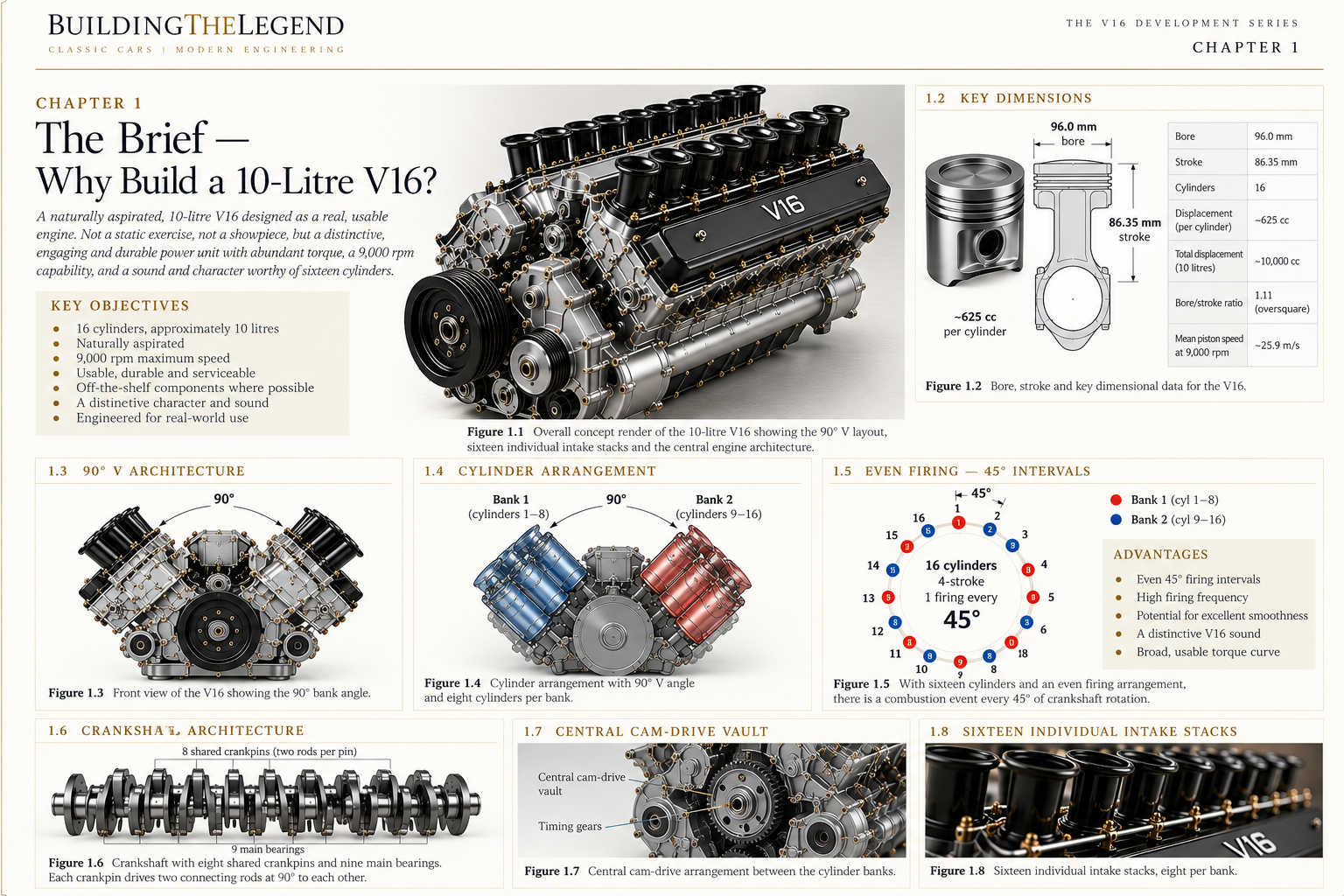
There are easier ways to build an engine.
If the objective were simply to produce a great deal of power, there would be no compelling reason to start with sixteen cylinders. Modern turbocharging can extract extraordinary outputs from engines half the size, while an established V8 or V12 architecture would bring with it an enormous catalogue of proven components and considerably fewer opportunities to make expensive mistakes.
But that rather misses the point.
At Building The Legend, the intention was to create something different: a large-capacity, naturally aspirated V16 designed from the outset as a real, usable engine. Not a static engineering exercise, not a collection of exotic numbers intended to look impressive on a specification sheet, and not an engine dependent upon extreme boost or impossibly high specific output to justify its existence.
Writing those numbers down was the easy part.
Starting with a blank sheet
The project began without an existing production V16 architecture that we intended to copy. There have, of course, been some wonderful sixteen-cylinder engines over the years, but the objective here was not to reproduce one of them. Nor did we want simply to join two existing engines together and disguise the result.
Instead, the V16 would be developed as its own engine. That meant beginning with the relationships that would ultimately govern almost everything else: cylinder dimensions, bore spacing, crankshaft architecture, connecting rods, bearings, liners, valve gear and the overall physical dimensions of the engine.
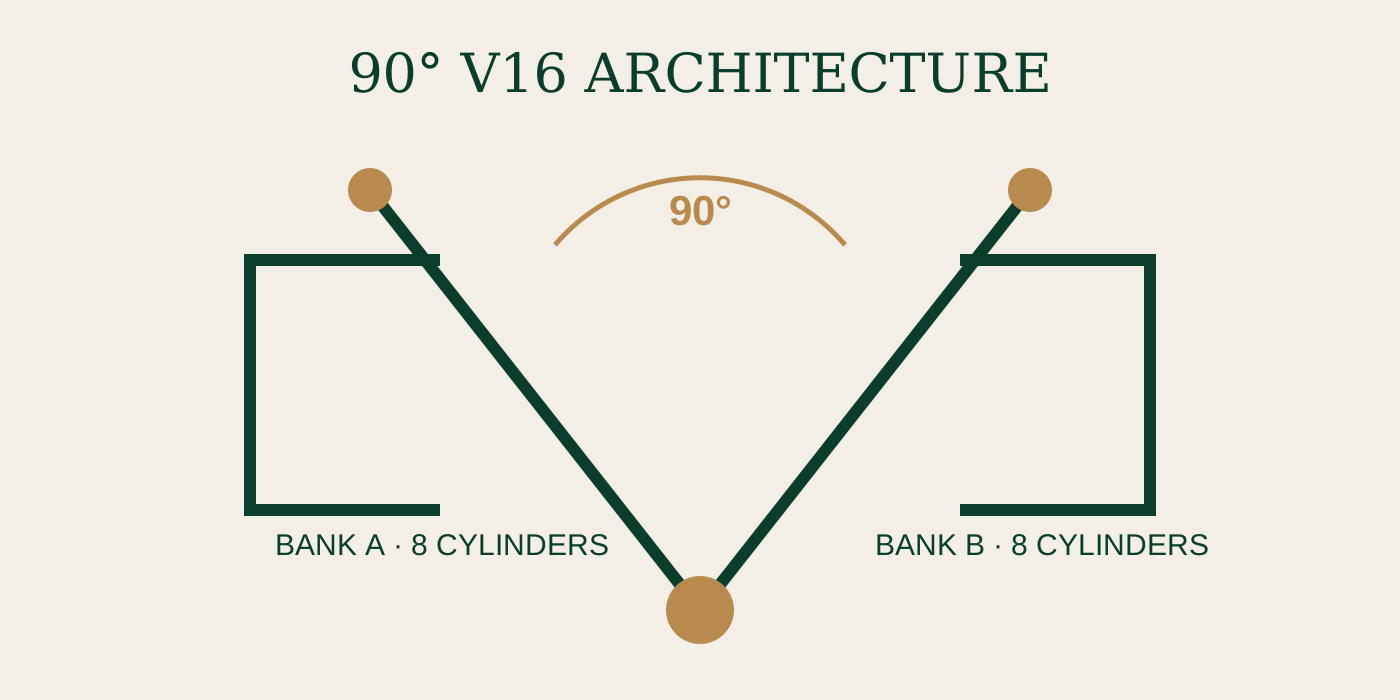
A 90-degree V angle was adopted. It provides a relatively low and wide architecture and, importantly, gives us useful possibilities for crankshaft phasing and primary balance. As later work would demonstrate, however, the words balanced V16 conceal considerably more complexity than might first be imagined.
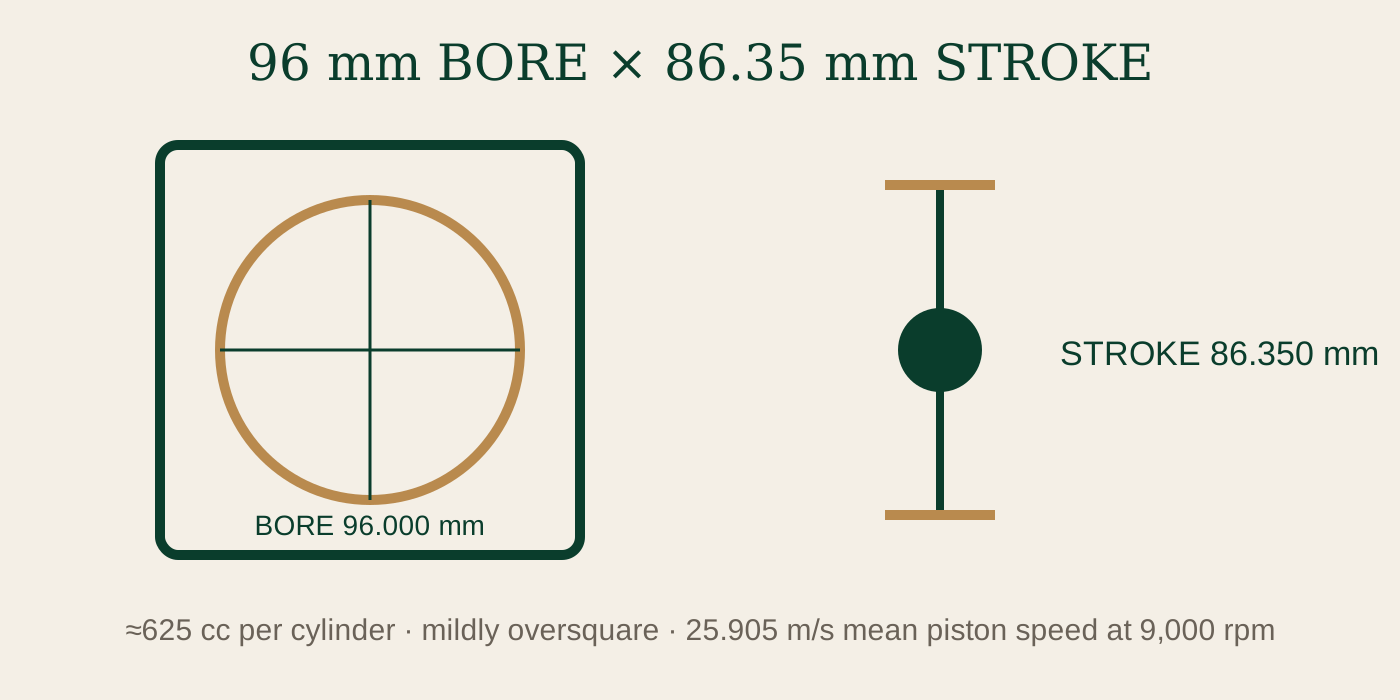
The bore settled at 96 mm. Once the target displacement was established at approximately ten litres, the arithmetic led us to a stroke of 86.35 mm. The result is essentially 625 cc per cylinder and a mildly oversquare engine — a much more appropriate starting point for the intended character than creating ten litres through a very long stroke.
Development brief
At 9,000 rpm, an 86.35 mm stroke gives a mean piston speed of approximately 25.9 metres per second. That is serious territory, but it is not absurd territory for a properly engineered high-performance engine.
9,000 rpm — but not at any cost
The V16 is not intended to spend its life at 9,000 rpm. Its natural operating territory should be considerably broader, with much of its useful life expected between roughly 3,000 and 6,000 rpm. Ten litres and sixteen cylinders should provide abundant torque without requiring the driver to chase the top of the tachometer.
Nevertheless, we wanted the mechanical architecture to be developed with 9,000 rpm as the maximum-speed design target. At these speeds, seemingly small differences in reciprocating mass become significant. Connecting-rod length affects angularity and piston acceleration. A few millimetres of counterweight radius can become extremely valuable. Crankshaft stiffness, journal overlap, fillet geometry, bearing loads and lubrication cease to be details that can conveniently be addressed later.
The engine therefore had to combine two rather different characters: the effortless torque expected from ten litres with the mechanical discipline required of a much smaller high-speed engine.
It also suggested a principle that has subsequently become increasingly important: lightness is useful, but reliability is more useful.
Bespoke where necessary, standard where sensible
A completely bespoke engine presents a temptation to design absolutely everything from scratch. We have deliberately resisted it.
There are components where a unique solution is unavoidable, and the crankshaft, crankcase, cylinder heads and ultimately the connecting rods are obvious examples. But there is little merit in creating a unique service component merely because we can. Where an established, high-quality production or competition component can do the job properly, our preference is to use it.
That philosophy has already influenced the engine profoundly. The cylinder liners led us towards a proven, commercially available 96 mm-bore wet liner. Rather than immediately commissioning a unique V16 liner, we have worked to accommodate an available component that can subsequently be replaced without requiring an owner to have a one-off part manufactured.
The same thinking applies to bearings. The crankshaft may be bespoke, but its bearing shells should not be. Our requirement has therefore been unusually strict: use off-the-shelf split bearing shells without modifying them. We will design our journals and connecting rods around an appropriate bearing rather than machining a standard shell to make it fit our engine.
Valve guides provide another example. The planned 7.90 mm valve stems allow us to use established, commercially available valve guides. This isn't cost-cutting. It is about serviceability.
Sixteen cylinders create their own problems
A V16 sounds wonderfully straightforward when described as eight cylinders on each bank. Mechanically, it isn't.
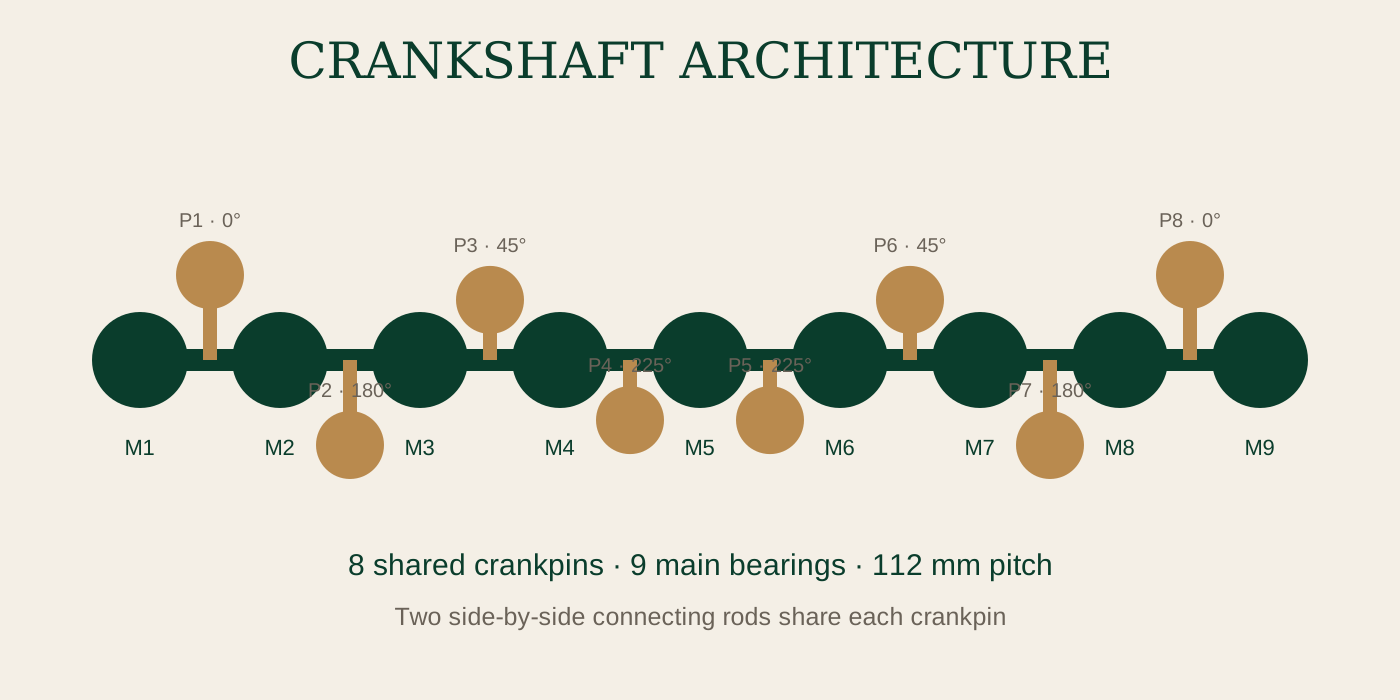
Sixteen individual crank throws would produce a very long engine, so the developing architecture uses eight shared crankpins, with two connecting rods operating side-by-side on each pin. Those eight crankpins are supported by nine main bearings.
Immediately, several competing requirements appear. The crankpins need sufficient width for two connecting rods and their bearings. The webs need sufficient thickness for strength. Journal fillets need sufficient radius to avoid creating fatigue-critical corners. The main bearings occupy axial space of their own. And all of this has to coexist with the cylinder pitch.
Every millimetre given to one component has to come from somewhere else. This eventually led us towards a 112 mm cylinder/crankpin pitch, but reaching a workable architecture required considerably more investigation than the finished number suggests.
There was another complication too: we needed somewhere to drive the camshafts. Rather than simply hanging the entire cam-drive arrangement from one end of what would already be a long crankshaft, the developing concept included a central cam-drive vault. Packaging that drive amongst sixteen cylinders, wet liners, crankshaft webs and main bearings became one of the first major three-dimensional challenges.
At one stage the vault arrangement interfered with the liners. That was an early reminder of something that has subsequently become a recurring feature of the project: an arrangement can look perfectly sensible in isolation and become impossible the moment the neighbouring system is introduced.
The crankshaft at the centre of everything
It became clear very early that the crankshaft would be the architectural backbone of the engine. Its final dimensions affect almost everything: block length, cylinder positions, rod dimensions, liner clearance, crankcase shape, cam-drive position and ultimately the external proportions of the finished engine.
We therefore resisted the temptation to begin by modelling beautiful cylinder heads or induction systems. Instead, much of the early CAD work was deliberately unglamorous: reference planes, crank axes, cylinder axes, bearing stations, case walls and packaging envelopes.
The first reference framework contained essentially no finished engine at all. It was a geometric skeleton from which the engine could grow. That proved to be the correct approach.
What should a V16 feel like?
There is also a less easily quantified part of the brief. A sixteen-cylinder engine ought to feel special.
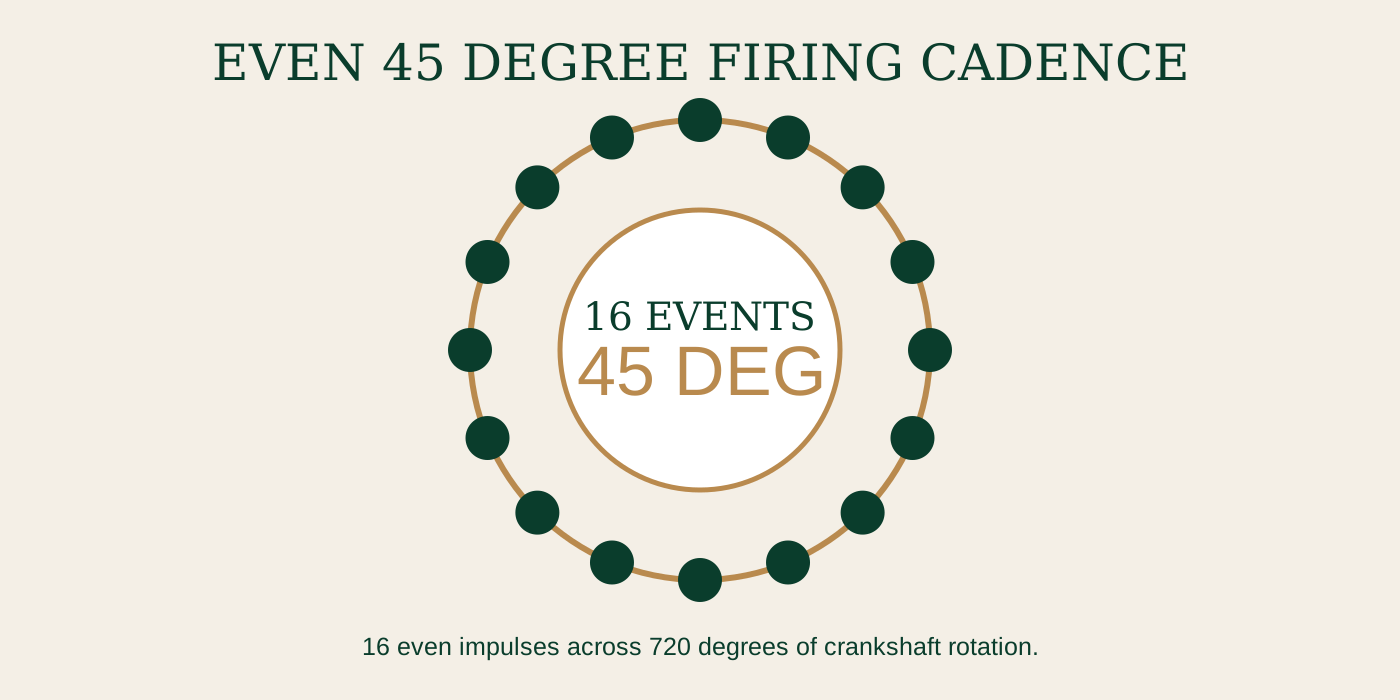
With ten litres divided amongst sixteen cylinders, the individual cylinders are not enormous. The attraction comes from combining displacement with firing frequency. With an even firing arrangement, a four-stroke V16 has a combustion event every 45 degrees of crankshaft rotation.
That promises an engine with a very different character from a large V8: extremely frequent power impulses, potentially exceptional smoothness and a sound that should become increasingly distinctive as engine speed rises.
We wanted to preserve that character rather than overwhelm it with turbochargers. The induction system therefore began developing around sixteen individual intake stacks, eight per bank, feeding through plenums. Current thinking uses 40 mm runner diameters with relatively short bellmouth stacks, although those dimensions will ultimately have to earn their place through analysis and testing.
The visual aspect matters too. An engine such as this should be something worth looking at when the bonnet is opened. But appearance is to follow engineering rather than dictate it. If a beautiful component interferes with a liner, weakens a crank web or makes the engine impossible to service, it loses.
The brief becomes an engineering programme
By this stage, what had started as the appealing idea of a 10-litre V16 had acquired a much more demanding definition: 96 mm bore × 86.35 mm stroke, sixteen cylinders in a 90-degree V, eight shared crankpins and nine main bearings, approximately 10 litres displacement, a working range centred substantially below its 9,000 rpm maximum, wet replaceable liners, four-valve cylinder heads, a central cam-drive arrangement and a naturally aspirated sixteen-runner induction system.
It would use a billet crankshaft, dry-sump lubrication and, wherever doing so improved reliability and future serviceability, proven proprietary components.
Most importantly, nothing would be considered sacred simply because we had already spent time designing it. Since beginning the project we have already encountered dimensions that didn't work, components that consumed too much axial space, CAD solids containing unexpected voids, counterweight envelopes that collided with liners and apparently attractive solutions that became less attractive once the numbers were calculated.
We have also designed components only to decide that buying something proven might be the better engineering answer.
And with the basic brief established, the first major question was waiting for us: how do you arrange sixteen cylinders, eight shared crankpins, nine main bearings and a central camshaft drive into a package that can actually be built?
That is where the V16 stopped being an idea and started becoming an engine.
Next: Chapter 2 — Finding the Architecture.